 Mexc
Mexc separates spot asset purchases from futures price exposure
· last updated
Mexc is a centralized crypto exchange where spot trades buy assets and futures trades create price exposure through contracts. Its order books match buyers and sellers, with maker or taker status determined by how each trade executes. That distinction affects trading fees, while perpetual futures also involve margin and funding. Access depends on location and account requirements. Deposits, withdrawals, Earn subscriptions, and automated trading add separate conditions around custody and asset availability.
An order's liquidity role affects its trading fee, while perpetual positions also introduce funding payments and liquidation risk.
Spot and futures lead to different account holdings
If the intended outcome is ownership of a listed cryptoasset, spot trading exchanges an existing account balance for that asset through a trading pair. The base asset is the asset being traded; the quote asset expresses its price. A futures position creates a contractual exposure that can be long or short. Perpetual futures have no scheduled expiry, and their collateral and settlement rules follow the contract. Buying an asset and opening a position on its price therefore create different holdings.
Funding the account is a separate choice. Crypto deposits bring supported assets into the exchange. Quick Buy offers region-dependent payment channels, including cards and third-party services, with identity verification requirements. P2P, or peer-to-peer trading, matches users for fiat purchases at seller-advertised prices. The platform holds the seller's crypto in escrow during an active order. A seller needs actual receipt of payment before releasing crypto; a payment screenshot does not establish receipt.
The catalog also extends beyond crypto. RealStocks provides brokerage-linked access to U.S. shares, while tokenized stocks and stock-price futures have separate product terms. RealStocks purchases create share holdings in brokerage custody. Tokenized stock rights depend on the issuer's terms; stock-price futures provide contract exposure without share ownership. Trading schedules vary by product.
Order prices and liquidity roles answer different questions
The orders available when a trade reaches the matching engine determine whether it adds liquidity to the book or immediately consumes existing liquidity. Bids record buying interest, and asks record selling interest. A market order seeks execution against available orders without a user-set execution price. A limit order sets the worst acceptable price: a ceiling for a purchase or a floor for a sale.
Spot trading also supports take-profit/stop-loss, one-cancels-the-other (OCO), and trailing stop orders. These controls govern conditional order placement, while available liquidity determines execution.
Consider a hypothetical spot purchase with a maximum fill price of 73 quote-currency units per asset unit, excluding trading fees. The buyer accepts waiting for a fill, and the chosen quantity satisfies the market's minimum and precision rules. The question is whether that price ceiling also ensures maker treatment.
With the lowest available ask at 79, the buy limit at 73 cannot match immediately. It rests on the book and receives maker treatment if an incoming order later fills it. If the lowest ask is instead 71 when the order arrives, an available fill at 71 meets the price ceiling. That immediate fill removes liquidity and receives taker treatment.
The purchase can meet its price condition under either outcome, with different fee treatment. If no matching seller arrives, the resting order remains unfilled. Insufficient matching quantity can produce a partial fill, leaving the remainder on the book. An accepted order alone does not establish a completed purchase.
Execution fees sit alongside spreads and other charges
The rate that applies to a filled trade depends on its market, liquidity role, account eligibility, and any active fee program. Mexc trading fee rates can vary by user region. The displayed schedule identifies the applicable maker and taker rates. Trade statements record the fee actually charged and its payment asset. A promotional zero rate concerns the eligible trading charge; it does not erase withdrawal charges or payment-provider costs.
The spread is the gap between the best bid and ask. Slippage describes a difference between an expected price and the actual execution price. Thin order-book depth can move successive fills through several price levels. These costs remain relevant when the trading fee is zero. Comparing an entry and exit therefore requires the executed prices, filled quantities, and fees on both sides.
MX fee deduction depends on account eligibility, an enabled deduction setting, supported pairs, and sufficient tokens in the relevant wallet. Its displayed benefit can change. Holding MX does not create a universal discount across every product.
Perpetual positions depend on margin and funding
When a futures position uses leverage, a smaller margin balance supports a larger contractual exposure, so price movements have a larger effect relative to that margin. Isolated margin assigns collateral to a particular position. Cross margin shares eligible collateral across positions, allowing losses elsewhere to affect the available buffer. Liquidation follows the contract's maintenance requirements and applicable fees. The fair price used for liquidation can differ from the last traded price.
Perpetual funding payments pass between long and short position holders. A positive rate means longs pay shorts; a negative rate reverses that direction. Funding equals position value multiplied by the funding rate. Stablecoin-margined and coin-margined contracts calculate position value differently, so the contract's units matter. The trading screen shows the selected contract's rate and funding countdown. Settlement intervals can vary by pair. Funding applies to positions held when settlement is processed, and deductions can affect the liquidation buffer.
Contract risk tiers also constrain position size and permitted leverage. A margin balance alone does not establish permission to increase a position beyond its applicable risk limit.
Trading tools change how orders reach the market
Copy trading follows a selected trader's futures activity, while grid trading places orders across a configured price range. Copy fills can differ from the lead trader's execution. Futures grids use USDT-margined contracts in hedge and cross margin modes, with liquidation exposure. MX fee deduction does not apply to these bots. The spot API, or application programming interface, supplies market data and order management under specific permissions. Eligible KYC-verified users can also access Futures trading through keys with Futures permissions, excluding Innovation Zone pairs. Futures API fees follow a separate schedule that overrides web and app promotions. Web and mobile interfaces provide manual trading access. Futures Demo Trading uses virtual funds for practice; its gains do not become real account profits.
Earn and token events apply separate reward rules
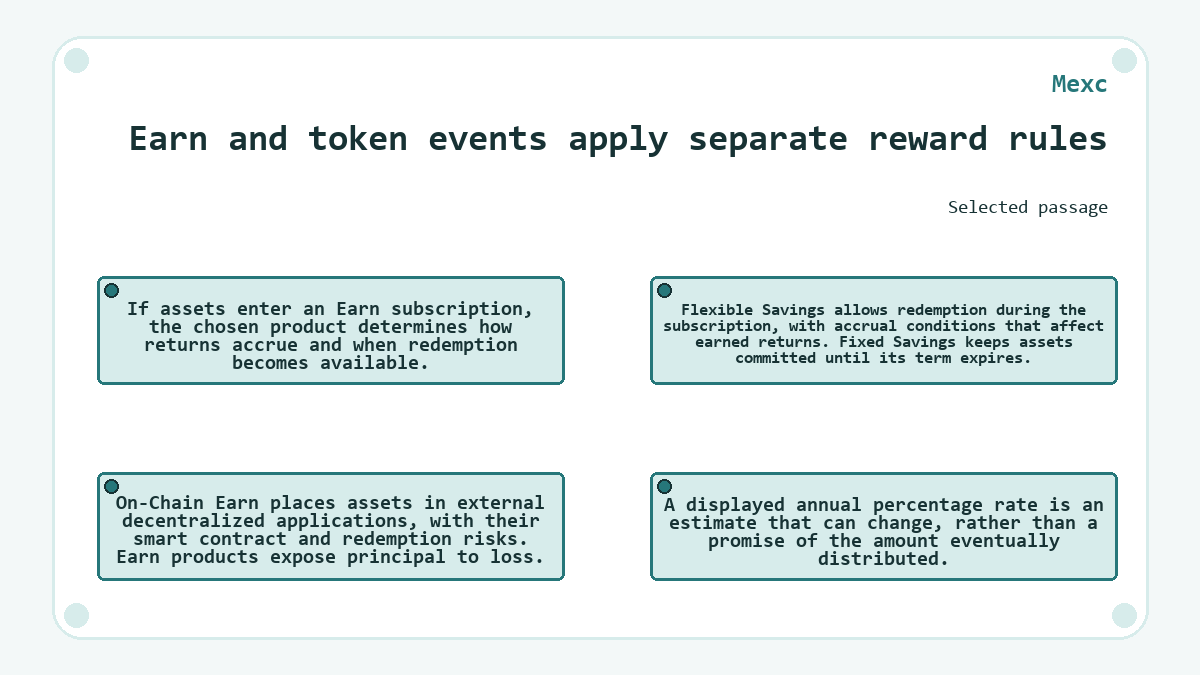
If assets enter an Earn subscription, the chosen product determines how returns accrue and when redemption becomes available. Flexible Savings allows redemption during the subscription, with accrual conditions that affect earned returns. Fixed Savings keeps assets committed until its term expires. On-Chain Earn places assets in external decentralized applications, with their smart contract and redemption risks. Earn products expose principal to loss. A displayed annual percentage rate is an estimate that can change, rather than a promise of the amount eventually distributed.
Launchpool distributes token rewards through designated staking pools, with project-specific eligible assets and allocation rules. It requires identity verification and excludes market makers, institutional accounts, and restricted-region users. Kickstarter uses MX commitments for project events and token distributions. The general Kickstarter FAQ specifies at least one completed futures trade and at least 5 MX in the Spot wallet, held for 24 consecutive hours before 16:00 UTC the day before an event starts. Individual event announcements set the applicable cutoff and can also require at least Primary KYC before the event ends for rewards. Committed MX is not frozen for that calculation. These programs have different eligibility and allocation mechanisms; ordinary token ownership does not establish entitlement to every reward.
Account balances depend on custody and transfer compatibility
Crypto held by the exchange relies on its custody and account controls. A wallet total and an available balance can differ because open orders reserve funds. Margin commitments, Earn allocations, and risk restrictions create other constraints on asset use. Moving assets between internal wallets changes their allocation within the platform; it is distinct from withdrawing them to an external address.
A deposit requires the supported asset and network combination, the designated receiving address, and any required memo or tag. Where a minimum deposit applies, a smaller amount is not credited and cannot be refunded. The sending network must match the exchange's deposit network. Mexc can pre-credit a deposit after initial confirmations for trading and internal transfers. Those funds cannot be withdrawn or transferred externally until the deposit reaches Credited Successfully status. Verification restrictions can also prevent funds from becoming available. Withdrawals separately depend on account permissions, available funds, network status, and the displayed fee and minimum. A token's trading availability does not imply that every network supports transfers.
Two-factor authentication helps protect account access, while risk-control reviews can restrict services. Proof-of-reserves snapshots describe the disclosed assets and recorded user holdings at a particular time. Those ratios do not determine an individual account's withdrawal permissions.
Regional access and verification come before product selection
When a jurisdiction is prohibited, identity verification does not override the restriction or make its residents eligible for the exchange's services. Prohibited jurisdictions include the United States, the United Kingdom, Canada, Singapore, and Mainland China. The list can change and is not exhaustive. The September 29, 2026 Netherlands wind-down notice assigns affected accounts withdrawal and restriction deadlines by batch. New positions and subscriptions stop on each account's restriction date, and remaining positions can face forced settlement. Affected users receive their assigned deadlines by email. Know Your Customer (KYC) requirements also affect deposits, withdrawals, and trading according to region and account prompts. Primary and advanced verification provide different permissions and limits. An eligible account needs the verification level and product permissions required for its intended purchase, position, or subscription.
Quick answers
-
Can I cancel the unfilled part of a spot order?
- An active spot order can be canceled for the quantity that remains unfilled. Cancellation does not reverse trades that have already executed. The corresponding reserved balance becomes available when cancellation succeeds, while completed fills remain in the trade record. Until cancellation succeeds, the unfilled remainder can continue matching.
-
What does an OCO order cancel when one component executes?
- A spot OCO order links a limit order with a take-profit/stop-loss order and cancels the other component when the limit order fills, even partially, or when the stop component triggers. Manually canceling either component also cancels its linked order. Both belong to the same trading pair. Reaching a stop trigger submits an order; liquidity still determines whether it fills.
-
Where can I see the individual fills behind a spot order?
- Trade History shows individual executions, including their fill prices, quantities, and times. Order History tracks the submitted order and its overall outcome, while Open Orders shows unfinished orders. A single order can produce several trade records, so its requested price and quantity do not necessarily describe every execution.
-
Does an API order receive the same promotional fees as a website order?
- The zero-fee spot campaign excludes API users from its promotional rates. That exclusion concerns the campaign, while the applicable API charge follows the account and market's fee schedule. A zero-fee label for manual trading does not establish an API execution's cost. Its actual fee appears in the trading records.
-
When do take-profit or stop-loss settings attached to a spot limit order become active?
- Take-profit or stop-loss settings attached to a spot limit order activate only after the main order fills completely. The corresponding exit order uses the preset price and filled quantity. Reaching its trigger does not guarantee execution, and an exit order below the market's minimum order amount becomes invalid.